

Complete Guide to Handpan Scales
Find out which handpan scale is right for you, learn about the different scales, compatibility and how to avoid mistakes before purchasing.

Table of contents
The handpan has been captivating audiences for around fifteen years thanks to its intuitive nature, accessibility and unique tone. It can be sweet, rhythmic and melodic all at once. A relatively new instrument, it has quickly spread around the world and boasts a very diverse audience. Used by musicians, wellness practitioners, meditation enthusiasts or simply the curious, the handpan delights music lovers looking for a simple and immediate means of expression.
But behind this apparent simplicity lies a central element: the melodic scales of the handpan. The entire personality of the instrument, its emotions, its sound colour, its possibilities for improvisation, and its compatibility with other musicians, derives directly from the chosen scale. Selecting the right sound scale is not just a technical matter: it is about deciding the musical universe that you’ll live in for years to come!
In this guide, we help you understand the basics, avoid mistakes and confidently choose the handpan scale that's right for you.
What are handpan scales?
Definition of the handpan scale and the role of notes
A handpan scale is a defined set of notes tuned to each other, distributed around the ding (the central note). Unlike a piano, a handpan does not offer all notes. You can only play between eight and more then 20 notes chosen by the manufacturer. This selection of notes creates the atmosphere, depth, brightness or tension of the sound. Here are some concrete examples:
- A minor scale, such as D minor - very popular - often evokes sweetness, introspection and a slight melancholy;
- A major scale sounds brighter. It is open, almost sunny.
These feelings are not theoretical. Even without musical knowledge, you immediately notice the emotional nuance of a handpan scale.
The major families of melodic scales: major, minor and 'Oriental'
Handpan scales can be classified into three main families, each associated with a particular atmosphere:
- Major scales: clear, cheerful, fresh sound. They evoke openness, lightness and fluidity
- Minor scales: deeper, more introspective, sometimes melancholic. They are ideal for sensitive improvisation or meditation
- “Oriental” or modal scales (Hijaz, Ragadesh, etc.): they offer a more exotic, mysterious colour, with characteristic intervals
These categories are not rigid definitions, but they help you quickly find the handpan scale that matches your desires.
Handpan scales and atmospheres
| Family | Atmosphere | Use |
| Major | Lively, cheerful, joyful | Fluid improvisation, live music, duet concert |
| Minor | Sweet, deep, meditative | Relaxation, wellbeing, emotional compositions |
| Oriental - Modal | Exotic, mysterious, fascinating | World music, cinematic atmospheres, creative research |
Handpan scales for beginners: where to start
Simple criteria for your first handpan scale
If this is your first purchase, you should opt for a handpan with:
- an easy-to-play melodic scale
- a reasonable number of notes
- good tolerance for mistakes
- a wide range for playing with others
According to this logic, scales in D minor such as D Kurd or D Celtic Minor remain the most reliable for beginners.
Compare the most popular scales to get started
Here are some key scales for beginners:
- D Kurd: versatile, varied, accessible, creates a sweet and melodious atmosphere
- Celtic Minor (D): cleaner, very intuitive. Ideal for leaving space for all notes
- Pygmy: deeper, more mystic
- D Major: cheerful, bright, an interesting alternative if you don't like minor sounds
Watching videos is essential to make an informed choice between two handpan scales that you like. Take the time to listen to different musicians playing the same scale. This will help you avoid confusing the personality of the scale with the style of the musician.
Alternate between listening with and without headphones, then simply ask yourself: Which one excites me more? If a scale makes you want to play from the very first second, this is often the best sign!
| Scale | Environment | Difficulty | Compatibility |
| D Kurd | Sweet and rich in nuances | Easy | Excellent |
| Celtic Minor | Smooth and clean | Very easy | Very good |
| Pygmy | Meditative | Easy | Specific |
| D Major | Bright | Easy | Specific |
The difference between D-Celtic Minor / D-Amara and D-Kurd Minor
Please note that approximately 80% of all handpans are tuned to D-Minor.
Below you can see the difference between the D-Celtic Minor scale (also known as D-Amara) and the D-Kurd Minor scale:

D-Celtic Minor / D-Amara

D-Kurd Minor
For these scales, 8 notes (out of 9) are the same; therefore, the two scales differ by only one note. D-Celtic Minor has a high C, while D-Kurd has a low Bb. The rest is identical. However, both scales can be played very differently.

D-Celtic Minor / D-Amara

D-Kurd Minor
Due to the low note (Bb, or B flat) on the Kurd scale, some notes are arranged differently than in D-Celtic Minor: in particular, there are three ‘opposite’ or ‘mirror’ notes for the scales.

D-Celtic Minor / D-Amara

D-Kurd Minor
This also shifts the chords from the ‘adjacent notes’, i.e. two notes that are next to each other. If you play the first two notes of D-Celtic Minor (A and C) together, these will be A and Bb (B flat) in Kurd (note: these two notes don’t sound harmonic when played together on the Kurd).
Advanced handpan scales and extended scales
Going beyond the classic handpan scales
As you progress, it can become interesting to explore:
- heptatonic scales (more notes, more possibilities)
- hybrid scales, combining two different tonal colours
- extended tunings on the lower part of the handpan (additional notes)
Although these terms may seem technical, they simply refer to handpans that offer more melodic options for playing in the Dorian, Phrygian, Aeolian or Mixolydian modes.
Combining different handpan scales when playing
An advanced musician can play several complementary handpans, for example:
- a low, melancholic handpan (D-Celtic Minor)
- a higher-pitched, brighter handpan (D-Major or A-Kurd)
This allows you to create contrasts and compose more complete pieces. Compatibility tables help to avoid dissonance.
Try out the handpan scales before making your purchase
Explore melodic scales online: videos, online shop and interactive tools
You can compare dozens of handpan scales from the comfort of your home on the Sound-Sculpture website.
Here are some tips:
- Don't be influenced by the musician's style. Focus only on the melodic scale.
- Always make a note of the name of the scale and the notes associated with it.
- Listen to several musicians playing the same scale, so you'll get a better idea of how the scale sounds.
Listening path
| Phase | Objective | Scales to listen to |
| 1 | Discover | D-Kurd, Celtic Minor |
| 2 | Compare | Pygmy |
| 3 | Explore | Hijaz, Dorian |
Try playing the scales on a piano or keyboard
Even if you have no experience, you can play the notes of a scale on a keyboard. This allows you to:
- understand if you like the overall atmosphere
- check if you like the intervals between notes
- eliminate scales that are too complex
It’s a perfect way to make sure it’s love at first sight before you buy!
Handpan scales and budgets: how to link musical choice and price
How does scale affect the price of a handpan?
Some scales are more expensive because they contain more notes, require more complex tuning, or are in higher demand. Beginners usually do not need to invest in the most expensive models. A simple, high-quality scale is more than sufficient.
The following indicative price ranges apply:
- handpans with 8–9 notes: standard scale, moderate price;
- handpans with 10–12 notes: extended scale, higher cost;
- more advanced models: hybrid or extended, more significant investment.
For a more comprehensive comparison, we recommend visiting our Handpan buying guide page.
Avoid scams: fake offers and non-original handpans
Before purchasing your instrument, be wary of models that are too cheap, unidentified manufacturers, unstable scales, and advertisements lacking details (e.g., no precise list of notes). Always compare the notes with a reference chart.
Before-purchase checklist:
- Verified manufacturer
- Warranty
- Possibility of a retuning service
- Transparency on the notes of the scale
- Clear audio demonstration
Sound-Sculpture selects each handpan, checks it and has it tested by craftsmen and enthusiasts who work with the instrument daily. Our goal is to ensure consistent, perfectly tuned and durable scales so that you can make your purchase with complete peace of mind.
We assist each musician in choosing their scale, and we are available to answer all your questions, verify a reference, or guide you towards the most suitable instrument.
Preserving the quality of your instrument: maintenance, storage and tuning
Clean and protect your handpan to maintain a stable scale
Remember that your scale will only remain stable and function properly if the instrument is well maintained. To start, avoid shocks and large temperature variations and always avoid direct sun. Clean your handpan gently regularly.
Retuning and durability of a handpan scale
Even a good handpan can lose its tuning slightly over time: this is normal. Professional retuning every 2–3 years allows you to regain the precision and musicality of the original scale.
To preserve the signature sound of your instrument, it is essential to entrust this phase to a certified manufacturer or craftsman who can respect the initial tuning and precision of the craftsmanship. Discover our handpan retuning service, our approach and how it works. We collaborate with several recognised manufacturers to ensure consistent and long-lasting monitoring of your instrument:
- Yishama
- Satya
- Handromeda
- Leaf Soundsculptures
- MAG Instruments
- Mudra
- Nala
- Noblet
- Omana and many others
Sound-Sculpture offers you a service designed to last, ensuring year after year, your instrument remains accurate, stable and fully expressive.
Organising handpan scales over the long term
Planning the evolution of handpan scales year after year
Rather than buying randomly or impulsively, you need to imagine a logical progression:
- a versatile first handpan (often D-Kurd or Celtic Minor);
- a second instrument that is lower or higher in pitch;
- a third complementary instrument that offers a different melodic nuance (modal or advanced).
This way, you can build a coherent sound universe!
Use the scale compatibility chart to choose your next handpan
For example, if you own a D-Kurd, the supported scales include Celtic Minor and Dorian. This allows you to play multiple instruments together without harmonic tension. To find out about scale compatibility, please refer to our compatibility chart. However, please do not hesitate to contact us for personalised advice based on your current instruments.
Only a few handpan scales are compatible with each other. Some notes harmonise, others are disharmonic and sound inconsistent. You will notice this immediately because it is like playing several notes on the piano at the same time: not all combinations sound consistent and harmonious.
If you want to play in a group, you should keep in mind that about 80% of handpans are tuned to D minor.
This table shows which of our handpan scales harmonise with each other. To do this, simply look for the desired scale in the left-hand column and see how compatible it is with other scales based on the colours (top row).
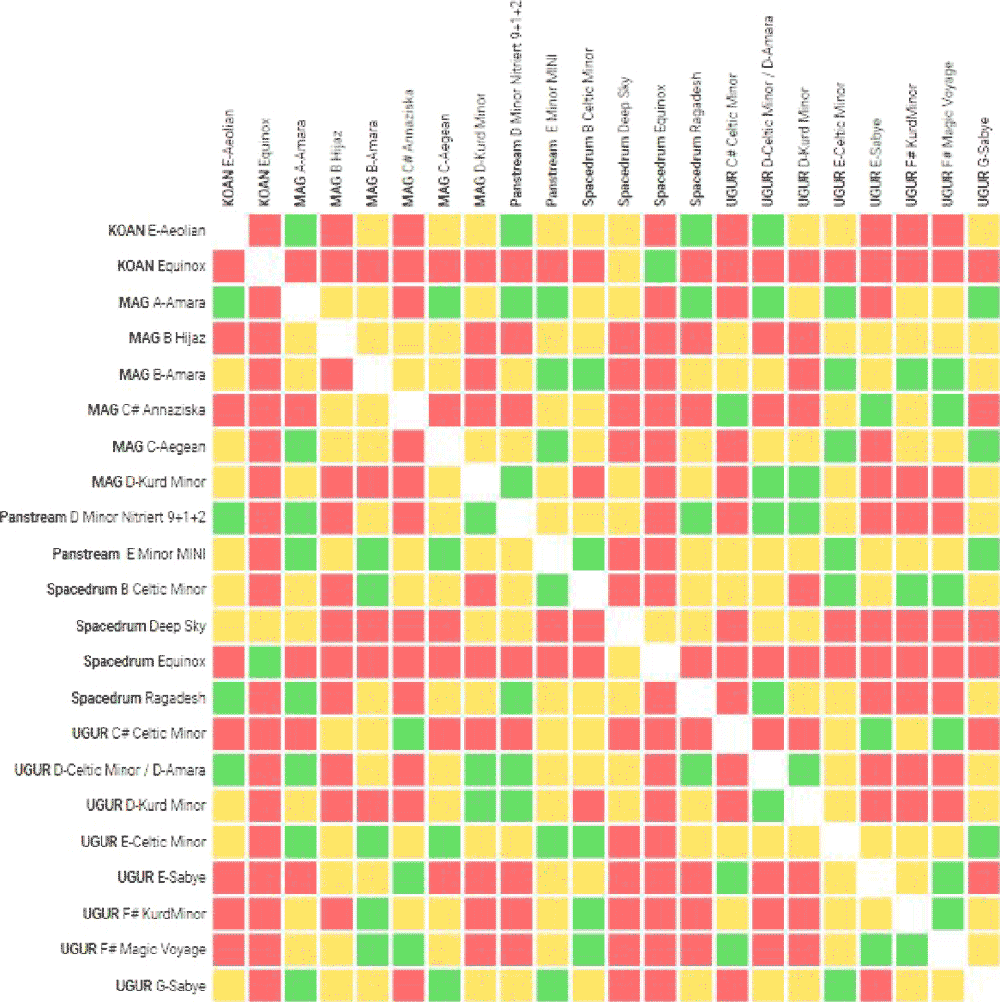
- These two scales fit together very well.
- These two scales are compatible with limitations.
- These two scales do not harmonize.
The handpan scale determines your musical world, the pleasure of playing and your progress. Whether it's a simple scale to start with or an advanced scale for composing, take the time to listen, compare, try and feel. The best decisions are often those guided by your ear and emotions.
Listen now to the scales available on the Sound-Sculpture shop and contact our team for personalised assistance!
FAQ
There is no single best scale in absolute terms, but the best options for beginners remain D Kurd and D Celtic Minor. They are intuitive, comprehensive and compatible with many instruments.
Two scales are compatible if their notes complement each other without creating too much dissonance. Consult a compatibility chart and compare the notes. Listening remains your best guide!
440 Hz is the standard and guarantees maximum compatibility. More than 95% of all handpans are tuned in 440 Hz. 432 Hz may be suitable for some wellness contexts, but it severely limits the possibilities of playing in a group unless all instruments are tuned in 432 Hz.
You can retune a handpan to correct deviations, but completely changing the scale is almost impossible. It's best to choose carefully from the outset!
With 8 to 12 notes, you already have a very versatile instrument. Remember: more complete handpans require more control.

About the author

Founder and managing director of Sound-Sculpture, handpan expert
Related articles
Handpan tuning: how does it work?
Discover how a handpan is tuned: expert techniques, high quality tools and all you need to understand how your instrument has been built or can be restored!

Handpan musicians: 10 artists redefining the instrument
Discover 10 handpan musicians pushing the boundaries of this remarkable instrument, from viral pioneers to UK street performers shaping the modern scene!
Letter notation vs Solfege: a guide for the modern music
Confused by Do-Re-Mi vs A-B-C? Discover the differences between solfege and letters, their history, and why handpan players prefer one over the other.

Major scale vs minor scale: the complete beginner's guide
A guide for beginners on major scale vs minor scale: learn how their patterns work and which one suits your handpan playing style.